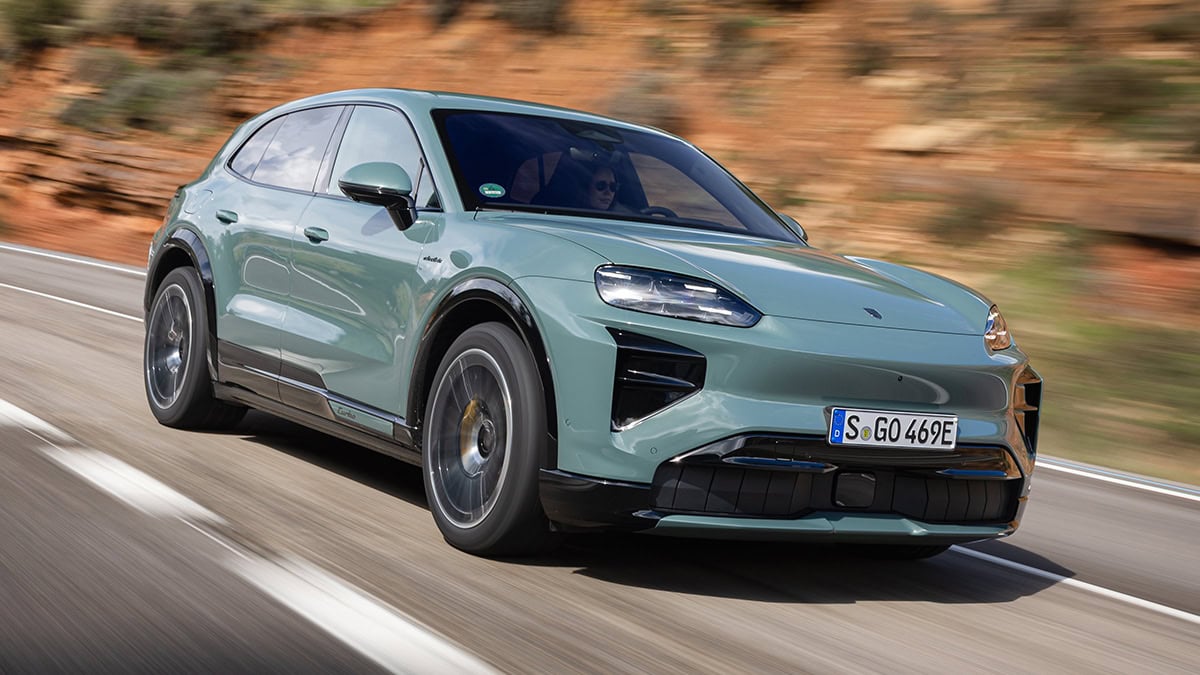

From zero to sixty-two in 2.5 seconds: the new Porsche Cayenne Turbo Electric accelerates at Formula 1 levels and, with 1,156 HP, breaks all performance records of the Stuttgart sports car manufacturer. We tested this brutal super-SUV in the Pyrenees.
Left foot firmly on the brake, right foot pins the throttle to the floor, and Sport Plus activates the Launch Control. Release the brake – and take off! The SUV shoots forward impetuously. Ten per cent slip on all four wheels is considered ideal for maximum traction. In a mind-boggling 2.5 seconds, 100 km/h flickers across the display. That is Formula 1 territory in a high-riding behemoth.
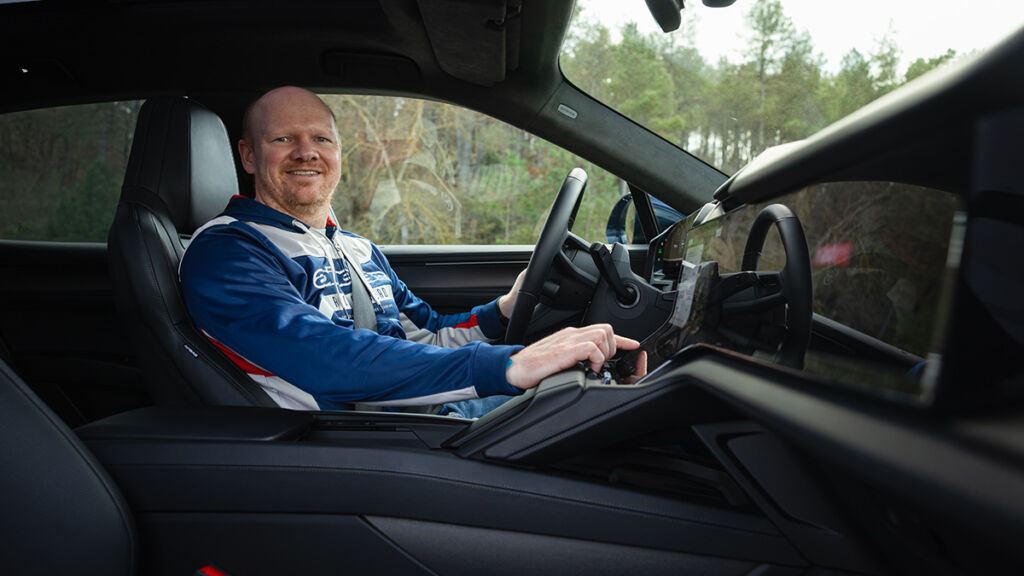
We are testing the Porsche Cayenne Turbo Electric in the southern foothills of the Pyrenees. With 850 kW (1,156 HP) in overboost mode, it crowns itself the most powerful production Porsche ever made. Even in standard mode, the Swabian machine effortlessly demolishes steep mountain passes with 630 kW (857 HP). To ensure the rear-axle electric motor doesn’t break an early sweat and lose power during this brutal workout, a low-viscosity synthetic oil cools it directly at the stator windings – a technology Porsche has brought straight from Formula E to the road.
From supercar to mud-plugger
Yet the Cayenne doesn’t just want to be a supercar; driving modes instantly transform its character from a wafting luxury saloon to a highly capable off-roader. For around €1,100, there is a dedicated off-road package featuring, among other things, a modified lower front apron and an approach angle of up to 25 degrees. Remarkably, Porsche is bold enough to approve the E-SUV for a towing capacity of up to 3,500 kilograms with the optional tow bar. Other manufacturers shy away from heavy trailers on EVs out of pure fear of losing image and range – a physical fact that applies just as much to combustion engines, however.
High-tech against the mass
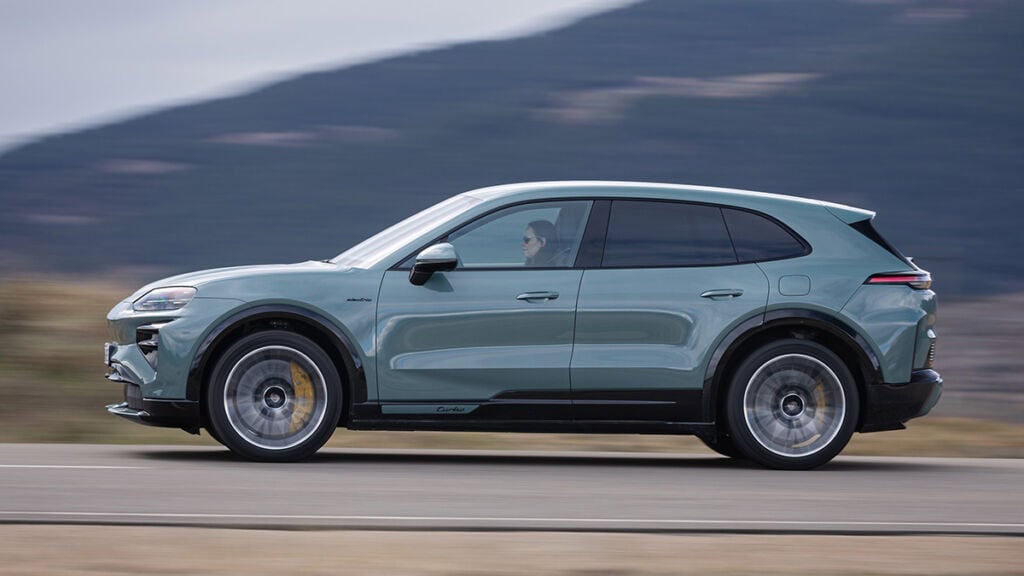
On the road, high-tech wizardry masks the massive 2,645-kilogram kerb weight. The optional rear-axle steering (€1,701) seemingly shrinks the giant when manoeuvring and threads it through hairpins with exceptionally little steering angle. The absolute highlight demands an extra €8,324: the Porsche Active Ride active suspension irons out bumps and keeps the body stoically level in off-camber corners. But physics cannot be completely outsmarted. Approaching tight hairpins, even the nearly €10,000 ceramic brakes (PCCB) can’t change the fact that stopping distance increases as the square of the speed. Anyone who anchors too late in the heat of the moment will reach the limits of what is possible.
Luxury lounge and high-speed charging
In the sumptuous interior, the downward-curved central display clusters all driving information. Why curved? It allows you to rest your hand and type while the infotainment system projects the keyboard exactly onto the bent section of the display – highly practical. The front passenger can stream or game on their own dedicated touchscreen (€1,951). Rear passengers travel first class thanks to standard electrically adjustable seats.
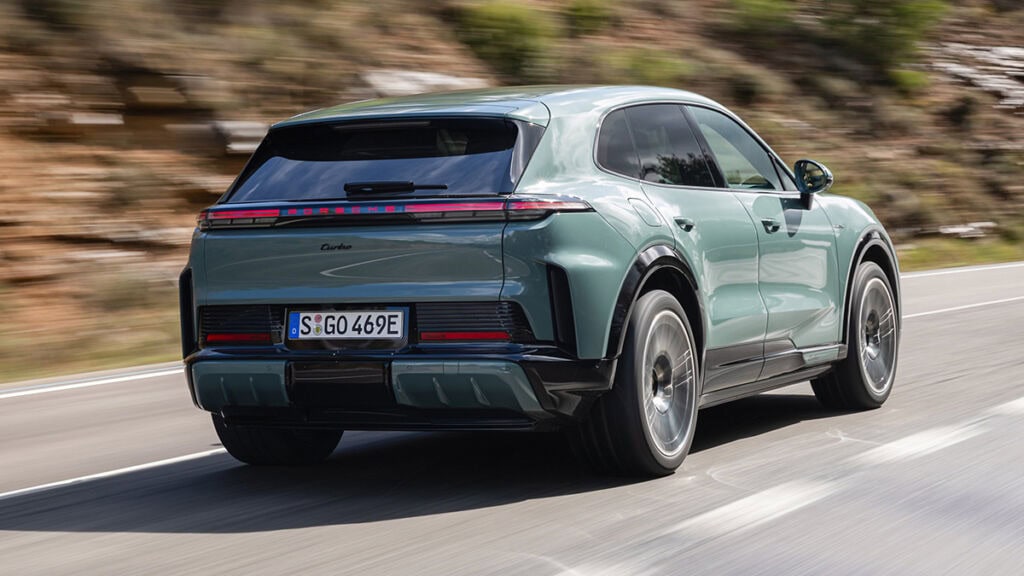
The spec sheet promises a range of up to 624 kilometres. The electronics cap the top speed at 260 km/h. At a high-performance charging station, the 800-volt architecture allows electricity to flow into the batteries at up to 400 kW. Under ideal conditions, the charge level leaps from ten to 80 per cent in just 16 minutes.
Porsche asks a minimum of €165,500. Anyone who enthusiastically ticks the options list will easily smash the €200,000 barrier, just like our test car at €209,170.
Verdict
Anyone fearing the German car industry had lost its edge in electric mobility will find proof in the Cayenne Turbo Electric of what Swabian engineering means today. This super-SUV fascinates with its incredible versatility, seamlessly morphing from a long-distance cruiser into an uncompromising corner-carver. The fact that such a hefty behemoth drives with such playful agility commands the utmost respect. And this is only possible because the powertrain, chassis and aerodynamics have been rigorously conceived as a cohesive whole.
Please note: Cars Insider tested a vehicle specified for the German market. Prices and equipment levels may vary in other countries.
FOLLOW US ON YOUTUBE!
THIS IS F1-Insider.com!